REVIEWS

Gary Grieve-Carlson, author of Olson's Prose
On Prologos and the GLOUCESTERMAN series:
“Prologos is among the most significant experiments in narrative form in the last fifty years of American fiction."
“In its formal virtuosity, in its brilliant, experimental systemization of plot and setting, in the deep seriousness with which it lays out ideas of tragedy, gender, work, religion, desire, moral responsibility … Bayliss's tetralogy stands as a signal accomplishment in American letters.”
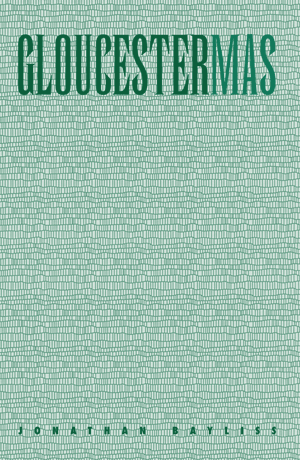
On Gloucestermas and the Gloucester trilogy:
“The world so vividly imagined in the earlier fiction of Jonathan Bayliss is brought here to a fully realized, fully rounded close.
“Gloucestermas connects many of the disparate ideas developed in the other novels, deepens the story of Caleb Karcist in unexpected ways, and offers some of the most remarkable conversations in all of American fiction.
“Jonathan Bayliss’s fiction sets a standard for the 'novel of ideas' that recalls the work of Herman Broch or Thomas Pynchon without the paranoia …
“These are novels in which everything matters: party politics, Christianity, dogs, being a spouse or parent, business efficiency, love, dance, myth, sex, growing old and dying — all pulled together by the special topos that is Gloucester, Massachusetts.
“The action unfolds in a world that is at once recognizable but altered: Gloucester is called Dogtown, Boston is Botolph, Democrats and Republicans are Catholicrats and Protesticans. This re-naming bumps the real world off its foundation just a few inches, with the result that we see things from a sharper, more incisive perspective. Lying behind it all is the adumbration of an enormous system encompassing all art, science, and technology— a general theory of culture whose shape the main characters are in their various ways working toward discerning. These are novels that imagine what it might mean to live a genuinely human life, rooted in a particular place. They occupy a special place in literature.”

Stuart Miller, author of The Picaresque Novel
On Gloucesterbook:
“ … a learned, intellectual, and demanding work — although it is never obscure, opaque, or capricious. The author is not trying to puzzle us. He takes us, rather, on a highly controlled exploration … There's a vivacity, a profusion of intellect, style, detail, an exuberance and plenitude that recall Melville's or, at other moments, Whitman's.”
Gerrit Lansing, author of Heavenly Tree, Northern Earth
On Gloucesterbook:
“Gloucesterbook is a genuine achievement, a literary work of true originality. The real hero here is Place.”

Peter Anastas, author of At the Cut and Broken Trip
On Gloucesterbook:
“With its narrative energy and totality of vision, Gloucesterbook is an important contribution to the art of the novel. Groundbreaking European fictions, such as Hermann Broch's The Sleepwalkers and Musil's The Man without Qualities, come to mind as comparisons … It returns the novel in English to its experimental roots, with the wit and outrageous inventiveness of Tristram Shandy. Jonathan Bayliss uses language in a way that makes our native tongue come alive for us as though we were experiencing it for the first time in all its freshness and hard-edge originality.”
On Gloucestertide:
“What is the American novel going to look like when it grows up?
“This is not a facetious question, considering that the pure American product, based on native experience and relatively free of European influence — Moby-Dick, for example — is only about a century and a half old.
“While there have been some amazing breakthrough fictions in language and form during the past fifty years, our mainstream novels have largely been realistic in conception, conventional in characterization, and colloquial in diction.
“Jonathan Bayliss’s Gloucestertide, the second in his three-volume sequence, Gloucesterman, turns all that on its head. The sheer scope of Bayliss’s achievement is nothing less than an American ambition as large as Melville’s or Dos Passos’s — three volumes of 600-plus pages each, encompassing what the novelist calls a 'counterfactual history' of one American place, 'Cape Gloucester,' whose principal municipality is 'Dogtown.'
“Equally, Bayliss’s language is not your demotic American. In the author’s hands our native tongue becomes a richer medium, precise yet imaginative, playful yet knowing, 'not by simplifying the complexity of English,' as Bayliss’s narrator explains, 'but by fixing more dimensions of abstraction.'
“By the same token, don’t expect the plot of Gloucestertide to disclose itself to you directly. Yet Bayliss’s story is not un-melodramatic. There’s love in these novels, even sex, and a great deal of the kind of humor that you might find in Laurence Sterne’s The Life and Opinions of Tristram Shandy. One of the more hilarious scenes in Gloucestertide is a description of the novel’s protagonist Caleb Karcist and his elusive sweetheart Lilian Mooncloud 'parking' late at night on the wharf at the old Tarr and Wonson Copper Paint Factory (Bayliss calls it 'Dogtown Net and Twine Manufactory').
“But I’m getting ahead of myself. What I want to say most importantly about Gloucestertide is that in calling his sequence of novels 'counterfactual history,' or 'what didn’t happen,' Bayliss, who has lived in Gloucester for 40 years, is creating a myth based on life in the community as he has experienced it as an ordinary citizen, as a business analyst and Controller at Gorton’s, as Mayor Leo Alper’s administrative assistant, and, finally, as City Treasurer. This is not a typical curriculum vitae for a writer of fiction. Nor is Bayliss attempting to 'tell all' in these novels. There are no deep secrets about city government that he is revealing, nor does he let us see behind the veil of a great corporation’s daily transactions, although his insights into the interface between corporate capitalism and cybernetics are incisive. Instead, Bayliss gives us the larger truths — the myths — about how people live in any human community. To him the novel is still 'our quintessential medium of experience.'
“In order to achieve this, Bayliss has created a structure for his tripartite sequence … The novels are the creation or 'transfiction,' of Controller Michael Chapman, former resident of Cape Gloucester, currently in 'exisle' (literally 'off-island') as Controller of Tubalcain Manufacturing Company, located in the Bay Area of 'Cornucopia'. Like God in the universe, Chapman is invisible in the narrative, though his hand is everywhere evident. Chapman has an agent in Cape Gloucester, Raphael Opsimath, who comes to explore the community’s 'magnetic attraction,' while studying as an MBA student at White Quarry College under Dogtown writer Ipsissimus Charlemagne, who, suspiciously, has both the great height and intellectual breadth of the late poet Charles Olson.
“Much of the action of Gloucesterbook is seen through Opsimath’s eyes; but the central consciousness of Gloucestertide is that of Caleb Karcist, friend of Chapman and Opsimath (a dog’s eye view of the action is also provided by Karcist’s Viking Shepherd, Ibi-Roy). Young Caleb is an associate at the Laboratory of Melchizedec and Mesocosm, a local religious order and economic and social 'think tank.' And one of the novel’s archetypal themes is Karcist’s quest for the identity of his father. Caleb is also writing a play, The Tower of Gilgamesh, about the legendary Mesopotamian ruler, who sought both his own origins and immortality. The text of Caleb’s play is folded into the narrative, offering a further commentary on the characters’ actions and a key to the deep structure of this innovative fiction.
“Like its predecessor Gloucesterbook, Gloucestertide is a demanding novel. It asks for the kind of patience and attention that many readers may have lost the habit of. But it is also rewarding, for Bayliss’s game of words and identities is only one level of the play of his remarkable intelligence, an intelligence that has for long been missing from most American fiction."
On Gloucestermas:
“Gloucestermas brings to a close Jonathan Bayliss’s monumental trilogy of novels about Gloucester, Massachusetts in the 20th century.
“One comes away from this extraordinary narrative feat, completed just before the author’s death, humbled by the force of Bayliss’s intelligence, the range of his imagination and the play of his nimble mind.
“Gloucestermas — indeed, the entire tetralogy, beginning with Prologos, which was Bayliss’s lifelong project — is what the art of the novel has always aspired to: the exploration of how we come to be who we are, on the very ground of our being.
“In an age of waning literacy Gloucestermas offers a challenge to be better than our troublingly escapist times, to reach beyond our foreshortened expectations to discover through Bayliss’s uncompromising vision what the narrative is truly capable of achieving.
“James Joyce gave us the living, breathing Dublin through the prism of myth; Jonathan Bayliss’s “counterfactual” Gloucester is no less vital, and his understanding of local and national political life is equally profound. Though set in the recent past and brilliantly weaving together all the narrative threads of the earlier books, Gloucestermas projects the reader equally into the future, charting the progress of our civic and sensual lives and the life of the American novel itself.”
Peter Du Brul, S.J.
On Gloucesterbook:
“It may be by chance that the background of the paperback cover is a fine fishnet. By chance or design (and in this book even chance is designed) the contents are the catch, and the cache, of a lifetime. It might take a lifetime to sort it all out, because it is so full of life, of intertwined lives, caught wiggling in a style and tone of voice, a language that slows the reader down to a pace that gives language and life a special attention.
“There is no short-cut through Gloucesterbook. The step-by-step covering of a beloved territory with two main characters — so far — whose lives and interests meet, whose inner workings are related in salient detail, requires and attracts and satisfies and exponentially rewards a close reading.
“What we have here is something grand, in the tradition of Joyce’s Dublin in Ulysses, Sherwood Anderson's Winesburg, Ohio, Faulkner’s Yoknapatawpha County, Walker Percy’s Feliciana Parish, but in another key. Somewhere between Robert Pirsig’s Zen and the Art of Motorcycle Maintenance and William Gaddis’ The Recognitions, with a pinch of Nathanael West.
“Yet even those prestigious references don’t help much here. This territory has got to be walked for itself. Gloucester: the granite, the oak trees, train station and docks, the fish, dogs, and bird shit, the iron works, studios, restaurants and bars, hotels, kitchens, showers, streets and squares, lanes leading off into the woods and wilderness brush where picnickers, lovers, and fugitives tend to drift. Gloucesterbook has all of that.
“A book of great elegance, of which we have only the first two 'Movements': that of Raphael, the Archangel from California, and that of Caleb, a Tobias who is also a spy in the Promised Land, and a Caliban clinging to the turf, accompanied by a dog that has no rival in American fiction.
“Doubtless there are more 'Movements' to come. But these two are already complete enough to explore a territory that will satisfy any reader hardy enough to bring her wits to it. Wits and patience for a journey that few novelists of our age would dare to challenge their readers with. The journey is not just into Cape Gloucester; into the lives of some 30 characters whose lives cross during those months between August 1960 and May 1961 — for this is an historical novel — but into the state of Vinland, the region of New Armorica, the U.S.A., Canada, Mexico and Western Civilization, in such a way that they become freshly recognizable.
“Admirers of Thomas Pynchon will here find a novelist who has plowed many of the same fields, but in such a different way. For the timing and the angles and the humor of Gloucesterbook are not those of 'Vineland' and its predecessors. This is a more 'quiet' love story.
In Caleb Karcist we have not only the Spy from the Book of Numbers, and the Caliban of Prospero, as well as Tobias with his dog, but we have a kind of Kafka, who cuts across the culture like a combination of “Mr. Blue,” Slothrop (from Pynchon’s Gravity's Rainbow), and Binx Bolling (from Percy's The Moviegoer). Is there anyone like him in American fiction? Or in legends? Where could he exist but in a “Gloucesterbook,” which is a legend.
“But this book is a legend of legends. Woven through the completely realistic and firmly detailed narrative of these two ‘Movements,’ there are a number of legends to be found, each more or less attached to a particular plot, place or character. There is fickle Jason and his lady friends; there are Theseus, the Minotaur, the Labyrinthe, Daedalus, and Ariadne. There is Prosper Ozone, the Cathode King, and Caliban. And there is Perdita, who may have wandered in from The Winter’s Tale. King Arthur, Lancelot (at least two of them), Moran la Fay, Mordred, not to speak of Beatrice, Dante, Faust, Gilgamesh, Melville, Camoens, South and North American Indians, Francis Bacon, a Tybbot who may be Tobit, and a Mary Tremont who may be just Mary Tremont ... they are all there!
“Where have we ever seen such an extended, incisive and affirmative meditation on the (Tudorite) Mass? How could anyone who read the book fail to be moved — at a level of Emotional Connection, and more — by the acolyte's trusting communion from the hands of the very priest who had tried to seduce him?
“This book is operating and thought out and felt through and crafted at levels that most of us readers don't deserve. It tries to reach us at a level of discernment and finesse and humor and wisdom that most popular cultural products have almost convinced us doesn't exist.
“Yet all of these legends are supported by the comings and goings of a little loner of a genius, unconsciously looking for his father, guided by an angel who has employed him, accompanied by his loving dog, as he finds his way to cure a woman or two of their demons, and is probably on his way to find a fortune as well. If only his good fortune to be the Duke of Dogtown.
“But what saves this legend from the weight of its legends is a language, a style, and a game of names that come to make sense and give sense to so many of our references that have lost meaning and salt. They are deeply linked to a growing love story, and search for the 'dromenon,' where Keats, Kant, Kierkegaard, Arts and Sciences, the Mass, Indian wisdom, magic, anamnesis and non-causality Meet.
“The labyrinthe is playful. New York is New Uruk, Vermont is Montvert, California is Cornucopia, Maryland is Magdalene. Readers find out other words for Democrats, Republicans, Communists, Catholics, Protestants, Rotary, Nixon, and Orson Welles, but Kennedy, Roosevelt, and Stevenson are called by their 'real names.'
“During a party at Rocky Bay, Rafe the Archangel — actually a California businessman — remarks: 'Maybe the names explain everything. If I could keep track of all the names.' Indeed. The names of the principal characters are richest and hardest of all, as if they shielded and housed their unknowable souls. But they will no doubt be decoded by future doctoral theses. By their very decoding they will come more deeply under the de(con)structive glare of the character set up at that particular entry to the labyrinthe, old Doc Charlemagne, the mentor of Rafe’s MBA thesis, whose presence in Dogtown is what brings Raphael to town in the first place.
“But the game of names is not the only game in this town. The rich, precise, detailed vocabulary eventually requires a reader either to skip or to go to a dictionary. To give up is to lose the war for one’s own language and the culture it supports. To take up the challenge of Gloucesterbook, to read it, to catch on to its vitality of language is an act of cultural liberation.
“For the book seems to ramble out like the branches of that great oak of the Mississippi that Raphael espies at the beginning of the novel as he flies over the Midwest, like the oak of the complex chart that Caleb designs to explain the incipient birth of one company from another on the stock market, like the oak in Caleb's backyard on Codfish Street. But as it rambles it also sinks in its roots, its finest tendrils of language.
“This is what gives the novel the special life it has, this care for detail, that at first may seem obsessive, as it slows down the narrative. The reader is in a hurry, since reading such novels has led him to think that he must ‘get on with it.’ But then one comes to realize that this detail, this timing, this tone is the narrative. It deserves the time it takes to follow it, and it can be trusted to come round, on its own terms, to the mainstream of the plot, which proves to have gathered force and grace by the apparent diversion.
“Gloucesterbook is a work that is grand, elegant, historically rooted, careful in its articulations, so well crafted, respectful and yet sometimes outrageously forthright, deeply human behind the mode of its comic understatement. By its language it explores ranges of experience that have to be written about in this way, in order to discern what is worth saving in this culture that the language supports and is supported by.
“The fine net of this book has caught our culture at its own chosen angle, and is serving it up, fresh, not frozen, prepared according to his own Gloucester recipe. Happy the readers who are invited to his feast. May we not have to wait too long for ‘Gloucesterbook 2.‘"